
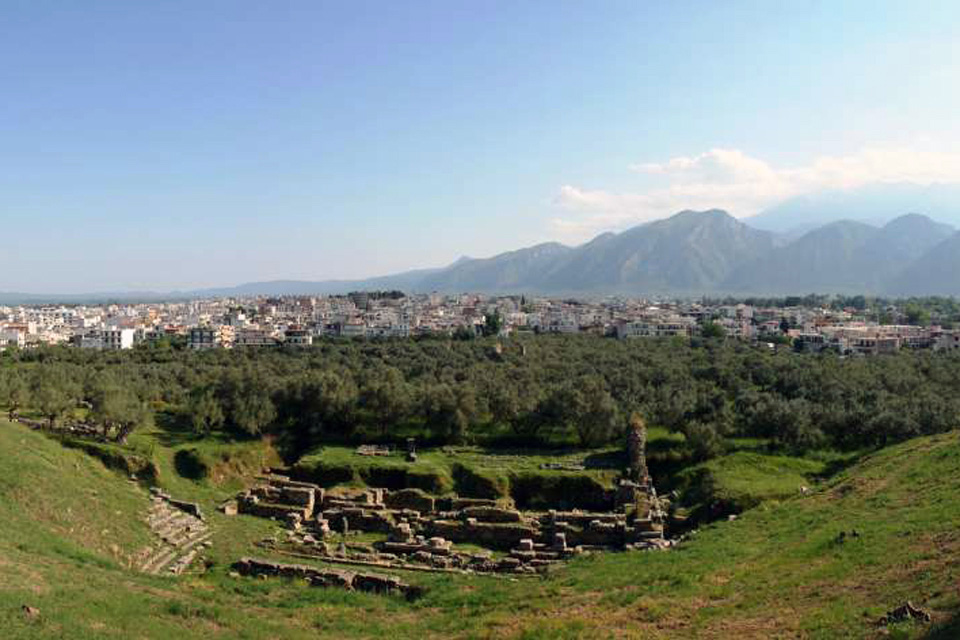







The ancient theater of Sparta is located on the southern slope of the Acropolis Hill. The existence of a theater in Sparta from the 5th century BC is confirmed by ancient writers and is closely associated with the performance of religious events such as the Gymnopaidiai. It has not been confirmed whether the theater of the classical period was founded in the same location visible to modern visitors.
The construction of the theater dates back to the Hellenistic or the Early Roman period, probably around 30 to 20 BC, and is closely linked to the hegemony of Gaius Julius Eurycles, a close friend of Octavian (Augustus). The Spartan theater is unique due to its size and the quality of its construction, evident from the use of local marble. This enormous structure could accommodate 17,000 spectators. The theater had a diameter of 141 meters and was one of the largest theaters in the Peloponnese. By the end of the 1st century AD, the theater was equipped with a monumental marble stage facade of the Corinthian order, the construction of which was funded by Emperor Vespasian. The marble facade of the retaining wall of the eastern parodos, where lists of Spartan officials and the cursus honorum were recorded, is a rare inscribed structure. The theater was used, with some changes and modifications, until the end of the 3rd to the beginning of the 4th century AD. By that time, the late Roman fortification had been built, which incorporated the western wall of the stage. After a period of abandonment, a Byzantine settlement was established in the area of the theater (10th to 14th centuries AD). Marble seats from the theater and some of the rubble stones of their bases were used as building material for the construction of Byzantine houses. With the founding of the modern city of Sparta in 1834, the stone materials were looted for use in the construction of modern Sparta.
Plan ahead and take advantage of official online rates.
Copyright © 2026 by Lakonia Guide
