
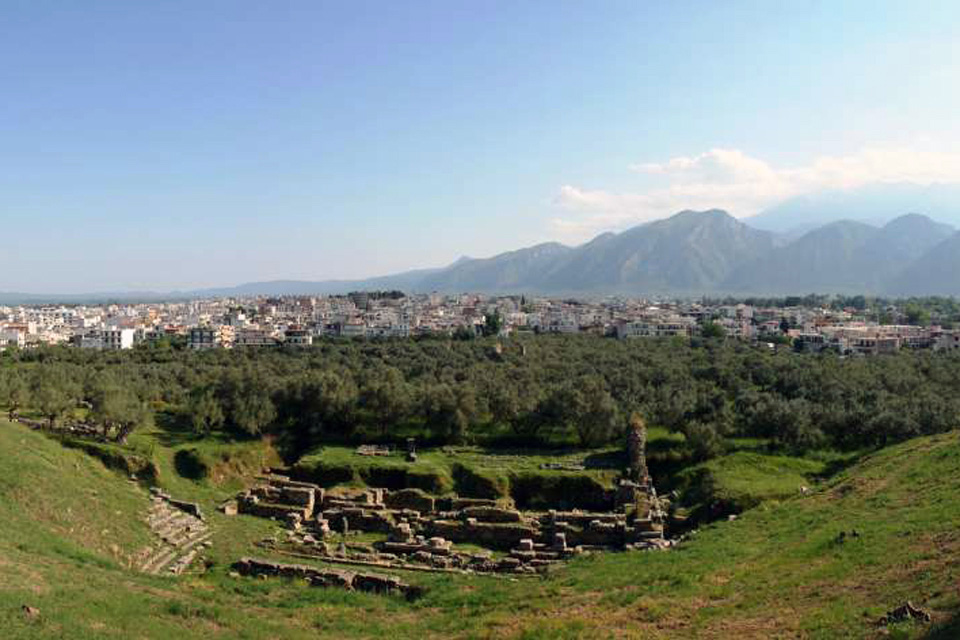
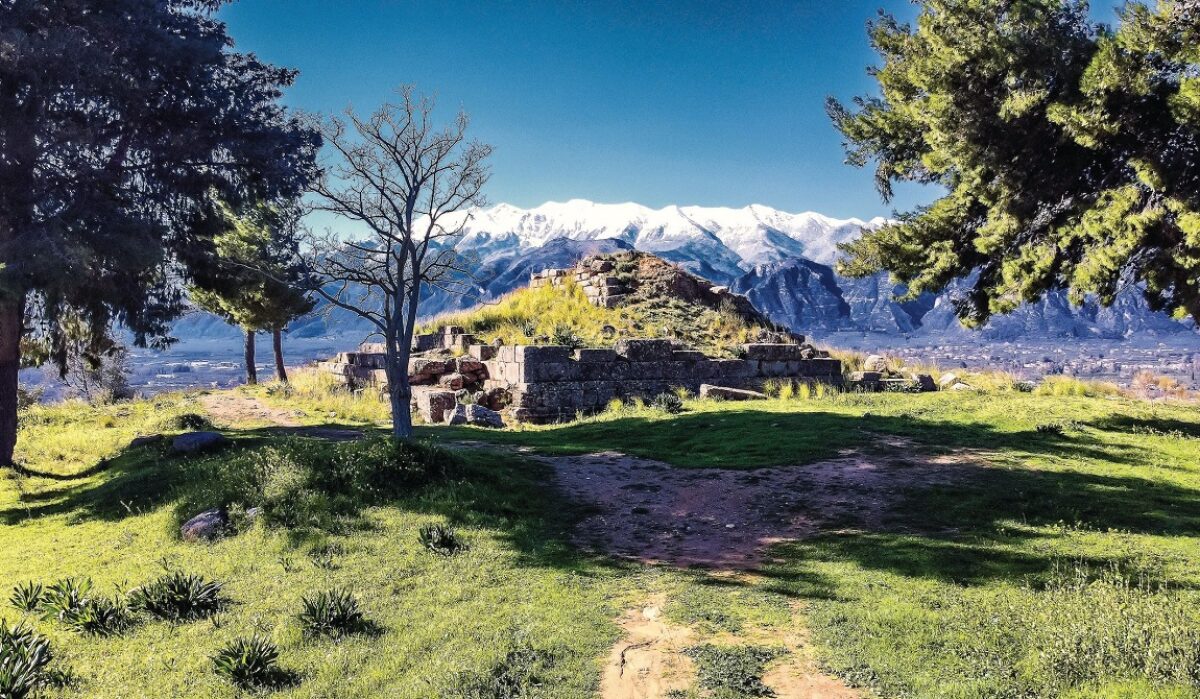

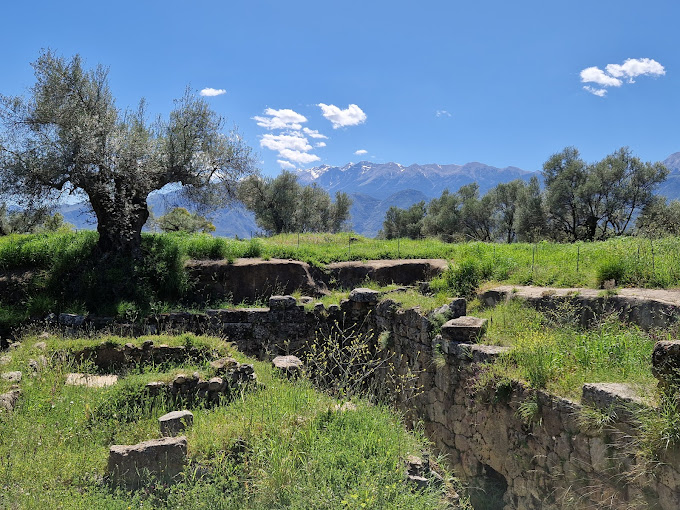
North of the Cyclopean Structure, a monumental stoic building has been revealed, known in the literature as the "Agora." The monument was excavated in the mid-1960s by Chrysanthos Christou. It is a large-scale stoa, of which only the southwest interior corner has been excavated. Its walls are constructed in the polygonal method using large boulders, except for their upper part, which is constructed from limestone in the pseudoisodomic system. The cross-walls, forming small spaces inside the stoa, are also constructed from limestone in the same manner.
The stoa is situated in the area where the city's market is located. Due to the slope of the adjacent western hill, it was likely two-storied on the southeast side and single-storied on the northwest, also serving as a buttress.
To the east and north of the building, foundations of houses and constructions from Byzantine times have been uncovered. The stoic building itself underwent additions and repairs during the Byzantine period.
The excavator dates the construction of the stoa to the 4th or 3rd century BCE and believes it underwent renovation in the 2nd century BCE. A plethora of evidence confirms the function and use of the building until the 3rd century CE. In the interior corner of the stoa, beneath a layer of destruction with strong traces of burning, the sculpted statue of Empress Julia Aquilia Severa (220–222 CE), wife of Emperor Elagabalus, was found. Today, it is preserved in the National Archaeological Museum (inv. no. X 23321). The empress, wearing a chiton and himation, stands facing forward with her right hand extended. What still impresses the viewer today are the extensive damages and distortions suffered by the bronze statue, giving it a strange, almost macabre appearance. The excavator attributed its condition to damnatio memoriae, i.e., the condemnation of the depicted empress to eternal oblivion, through the abuse of her image. Based on this perspective, the form has been identified with women of the Severan dynasty who suffered this punishment, such as the mother of Emperor Alexander Severus, Julia Mamaea, Elagabalus' wife Annia Faustina, and Plautilla, the wife of Caracalla. However, according to the latest research findings, the distortions are likely due to the construction materials that crushed the statue at the point where it stood when the building collapsed after a fire. This fact, combined with details in the depiction of the form, such as the hairstyle and individual facial characteristics, associate it with Julia Aquilia Severa, who is not known to have been condemned to damnatio memoriae.
The partial excavation of the building does not provide researchers with sufficient evidence to identify it with any specific monument. A popular opinion is that it is the Persian Stoa, a building that impressed the traveler Pausanias during his visit to the market of Sparta in the 2nd century CE. In the Persian Stoa, constructed from spoils of the Persian Wars, statues of Persian captives were supported on pedestals instead of columns. According to another opinion, the monumental stoa was part of a larger complex of two-story stoas that defined the space of the market to the southwest.
Plan ahead and take advantage of official online rates.
Copyright © 2026 by Lakonia Guide
