




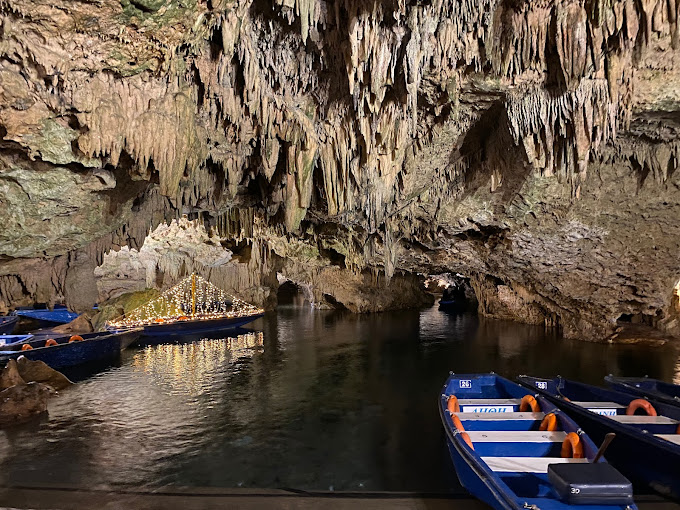
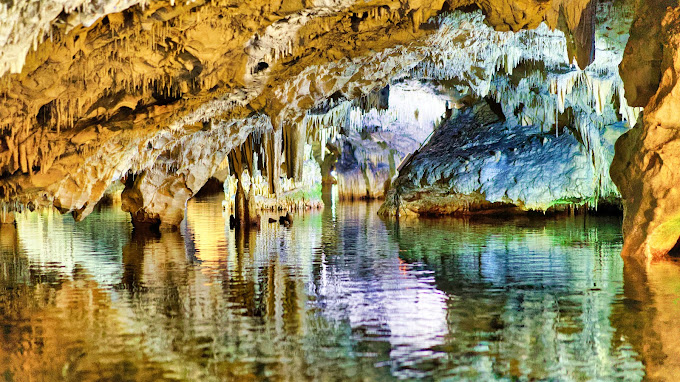
The Cave of Diros, also known as Glyfada (or Vlychada), is a visitable cave located on the western coast of Laconian Mani, in the Bay of Diros, Municipality of Eastern Mani.
Its existence was known to locals from around 1900. In 1949, the founders of the Hellenic Speleological Society, Yiannis and Anna Petrochilos, began to systematically explore it. By 1960, 1,600 meters had been explored and mapped, while today the known length of the cave exceeds 15 kilometers. The first underwater exploration took place in 1970. At one point in the cave, the depth reaches approximately 100 meters.
The cave began to form hundreds of thousands of years ago. The stalactites and stalagmites found underwater today were formed when the sea level was much lower than it is today. The water inside is brackish and has high hardness. Its temperature is about 14°C, while the air ranges from 16 to 19°C.
Its natural entrance has a diameter of only half a meter and is very close to the sea surface. In earlier times, the cave had other entrances which gradually closed.
Inside the cave, fossilized bones of panthers, hyenas, lions, deer, bats, and the largest concentration of hippopotamus bones in Europe have been found. Near its natural entrance, ceramics indicating human presence have been discovered.
220 meters east of Glyfada is the "Alepotrypa Cave," which contains petroglyphs.
Plan ahead and take advantage of official online rates.
Copyright © 2026 by Lakonia Guide
