
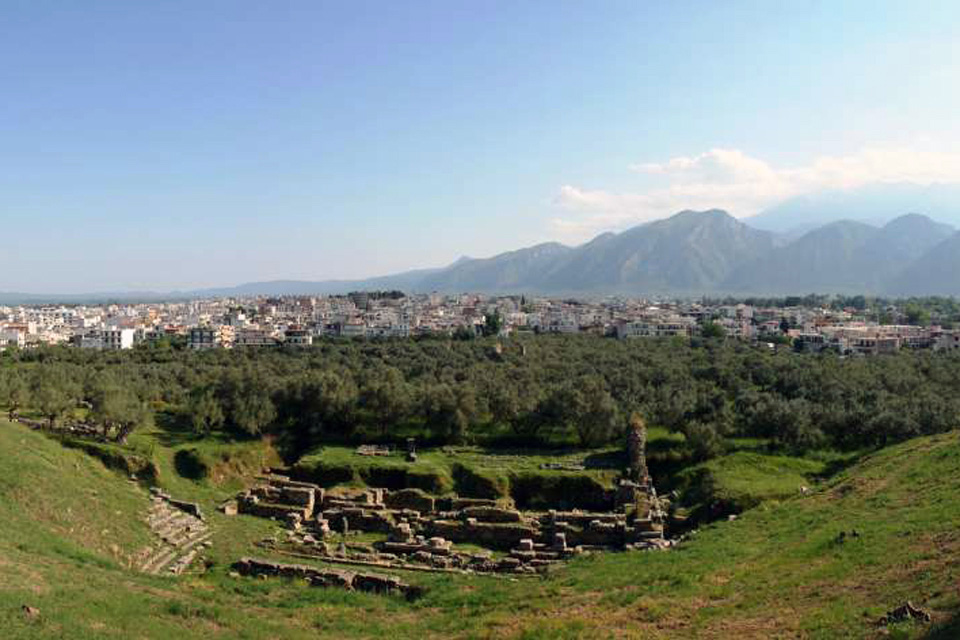


When the modern city of Sparta was founded in 1834 by decree of King Otto, the acropolis of the ancient renowned city, with its already identified antiquities, became the southern center upon which the new Sparta was built and developed, literally on the remains of the ancient city. In the spirit of European romanticism, the effort to revive the glory of an ancient Greek city within the framework of the reconstruction of the new Greek state is reflected not only in the founding of Sparta itself but also in the Hippodamian urban plan, the neoclassical morphology of its public buildings, and even in the choice of its location. However, the harmonious coexistence of ancient and modern Sparta proved to be a difficult challenge over time, as in a small place hosting human works of centuries, the clash between the new and the old is inevitable.
Both the ancient and the new city were crowned by the archaeological site of the acropolis and the agora of ancient Sparta, the administrative and religious center, where monuments representing the historical course of the ancient city, its changes, and its character over time have come to light. These remains testify to the continuous and systematic use of the space from the early geometric to the late Byzantine periods.
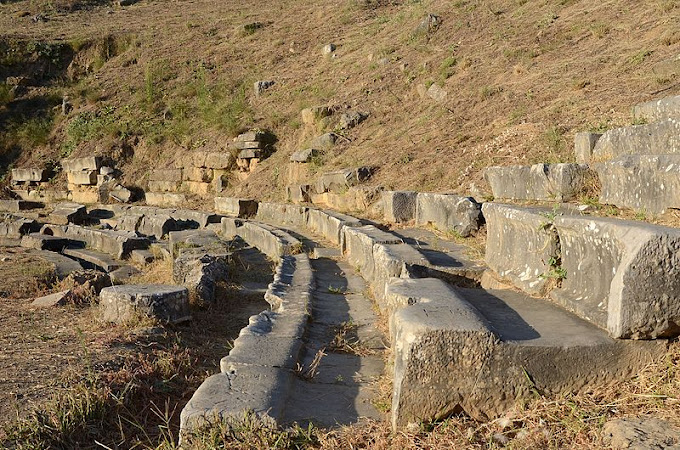
The remains of ancient Sparta attracted the interest of foreign travelers and researchers as early as the 15th century. However, in the 18th and 19th centuries, this interest was manifested more systematically and led to the identification, recording, depiction, and even exploration of ancient sites and monuments. In 1875, Panagiotis Stamatakis, as a delegate of the Archaeological Society of Athens, promoted the alienation of the ancient theater. The so-called "Circular Building," located in the southern part of the agora, is the first monument systematically excavated in 1892 and published by archaeologists C. Waldstein and C.L. Meader of the American School of Classical Studies. The British School of Archaeology worked systematically on the acropolis and the agora of Sparta throughout the 20th century. In the 1930s, Adamantios Adamantiou and Georgios Sotiriou worked on the acropolis, and after the interruption caused by World War II, research continued from 1960 to 1962 with the expenses of the Archaeological Society and under the supervision of Chrysanthos Christou, who revealed a monumental stoa in the area of the agora. In 1974, Georgios Stainhaouer worked on the theater, excavating part of its orchestra. In 2007, a five-year research program on the theater began, in collaboration between the (former) 5th Ephorate of Prehistoric and Classical Antiquities and the 5th Ephorate of Byzantine Antiquities with the British School of Archaeology. In 2012 and 2013, a "Study for the Restoration of the Ancient Theater of Sparta" was prepared and approved by the Central Archaeological Council. This study was funded by the Stavros Niarchos Foundation and entrusted to a consultant from the non-profit organization "Diazoma."
Protection and enhancement works were systematically carried out for the first time on the entire archaeological site during the period 2011-2015, as part of the project "Protection, Formation, Enhancement, and Integration of Archaeological Sites of Sparta," which was included in the Operational Program "Western Greece-Peloponnese-Ionian Islands 2007-2013". Initially, the (former) 5th Ephorate of Prehistoric and Classical Antiquities undertook its implementation, and later the Ephorate of Antiquities of Laconia. With the completion of the project, the city of Sparta acquired an organized and accessible archaeological site, with facilities for the public, signboards for marking and information, touring routes, and platforms for rest and observation for visitors. The enhancement of the central archaeological site of the city and the creation of touring routes that connect its monuments contribute to forming as comprehensive an image as possible of ancient Sparta, while also organizing subsets that are representative and easily accessible to visitors, contributing to the approach of individual aspects of the life of the ancient, Roman, and Byzantine city.
The Acropolis
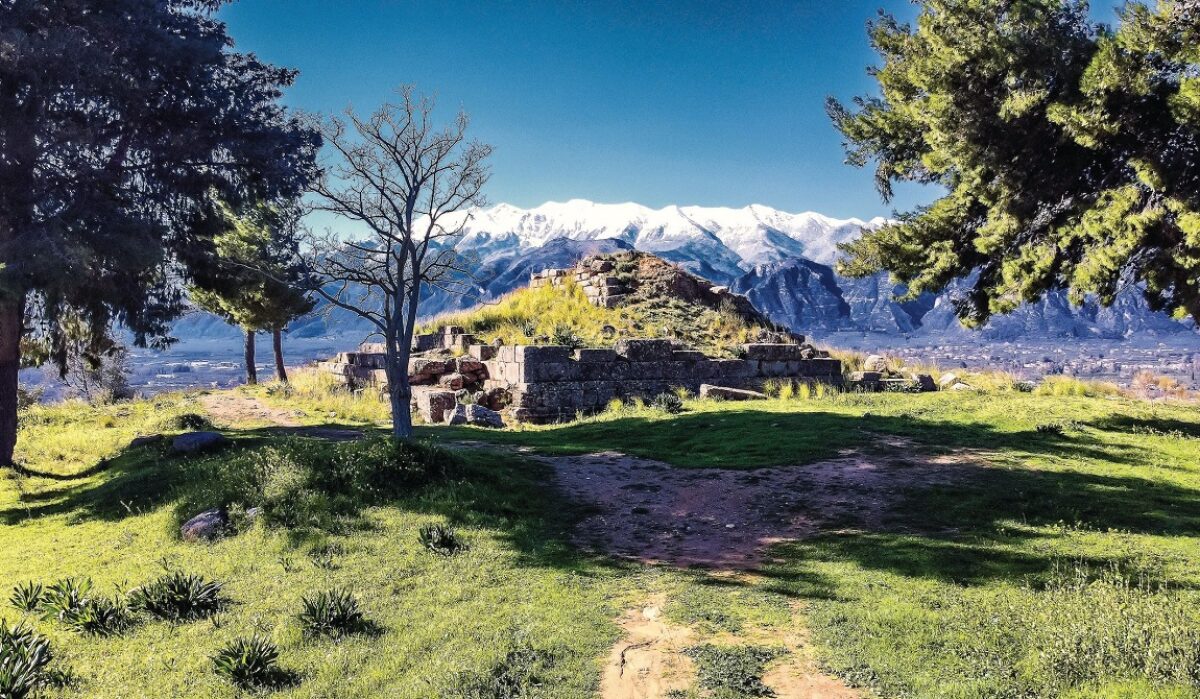
The acropolis of ancient Sparta is the highest of the smooth hills to the north of the city. A valuable source of information about the topography of Sparta, not only in Roman but also in classical times, is the traveler Pausanias, who visited the city in the mid-2nd century BC. From the traveler, as well as from other ancient sources, we learn that on the acropolis there was one of the most important and oldest sanctuaries of Sparta, the sanctuary of Athena Polioukhos or Chalkoikos. Pausanias, near the sanctuary of Athena Chalkoikos, encountered other cultic spaces, such as the sanctuary of Athena Ergane, dedicated to the Muses, the temples of Zeus Kosmetas and Ares Aphrodite, as well as stoic constructions, the tomb of the mythical king Tyndareus, statues, and dedications.
The Agora
The area occupied by the agora of ancient Sparta is placed by most scholars on a plateau on the hill of Palaiokastro, to the east of the acropolis. Thucydides focuses on the absence of luxurious buildings and temples from the Sparta of the 5th century BC, and on the mismatch between the city's image and the power and glory of the Spartans during the Peloponnesian War. The historian states: "For if the city of the Lacedaemonians were to be deserted, and both the temples and the foundations of the buildings remained, I think that after a long time had elapsed there would be great disbelief in the power of those who had possessed it, in the opinion of posterity, to have been so great as they were... Neither a city with population, nor magnificent temples and buildings constructed...” (Thuc. I.10.2). However, the agora of the 2nd century BC, where the administrative and religious functions of the city were concentrated, impressed the traveler Pausanias, who characterizes it as "worthy of sight" (Paus. III.11.2) and mentions a plethora of sanctuaries, monuments, tombs, and public buildings that he encountered in the wider area. Among others, he mentions the council chamber of the Gerousia, the buildings of the Ephors, the temples of Caesar and Augustus, the sanctuaries of Ge, Agraia Athena, Xenios Zeus, and Xenia Athena, the tomb of Orestes, the colossal statue of the Demos of Sparta, and the statue of the Agora Hermes with the child Dionysus. He is particularly impressed by the luxurious theater and the Persian Stoa, the most imposing of the buildings in the agora. Most of the monuments encountered by Pausanias in the agora area date back to the archaic and Roman times, periods of particular prosperity for Sparta.
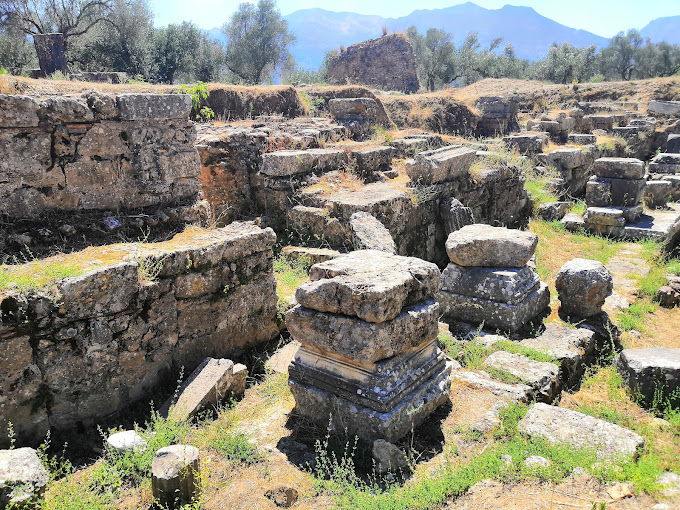
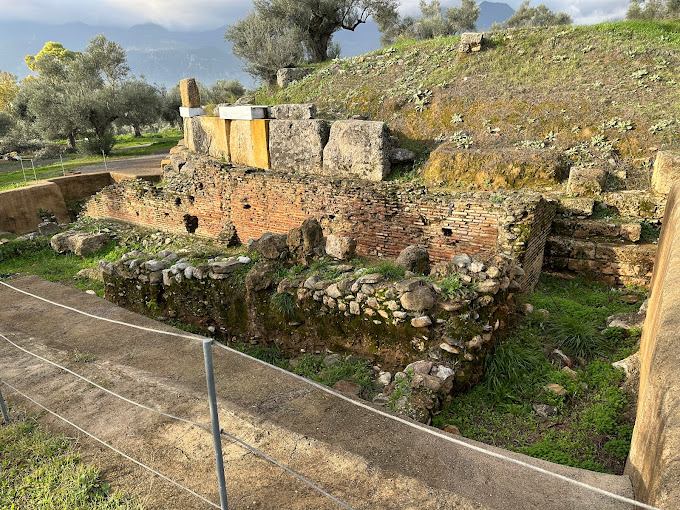
Today, in the area of the acropolis and the agora, the remains of buildings serving various uses and functions over the centuries are visible. These include monuments of archaic and classical Sparta, stoic constructions, public buildings, and private houses of Roman times, temples, public buildings, and houses of Byzantine times.
Plan ahead and take advantage of official online rates.
Copyright © 2026 by Lakonia Guide
